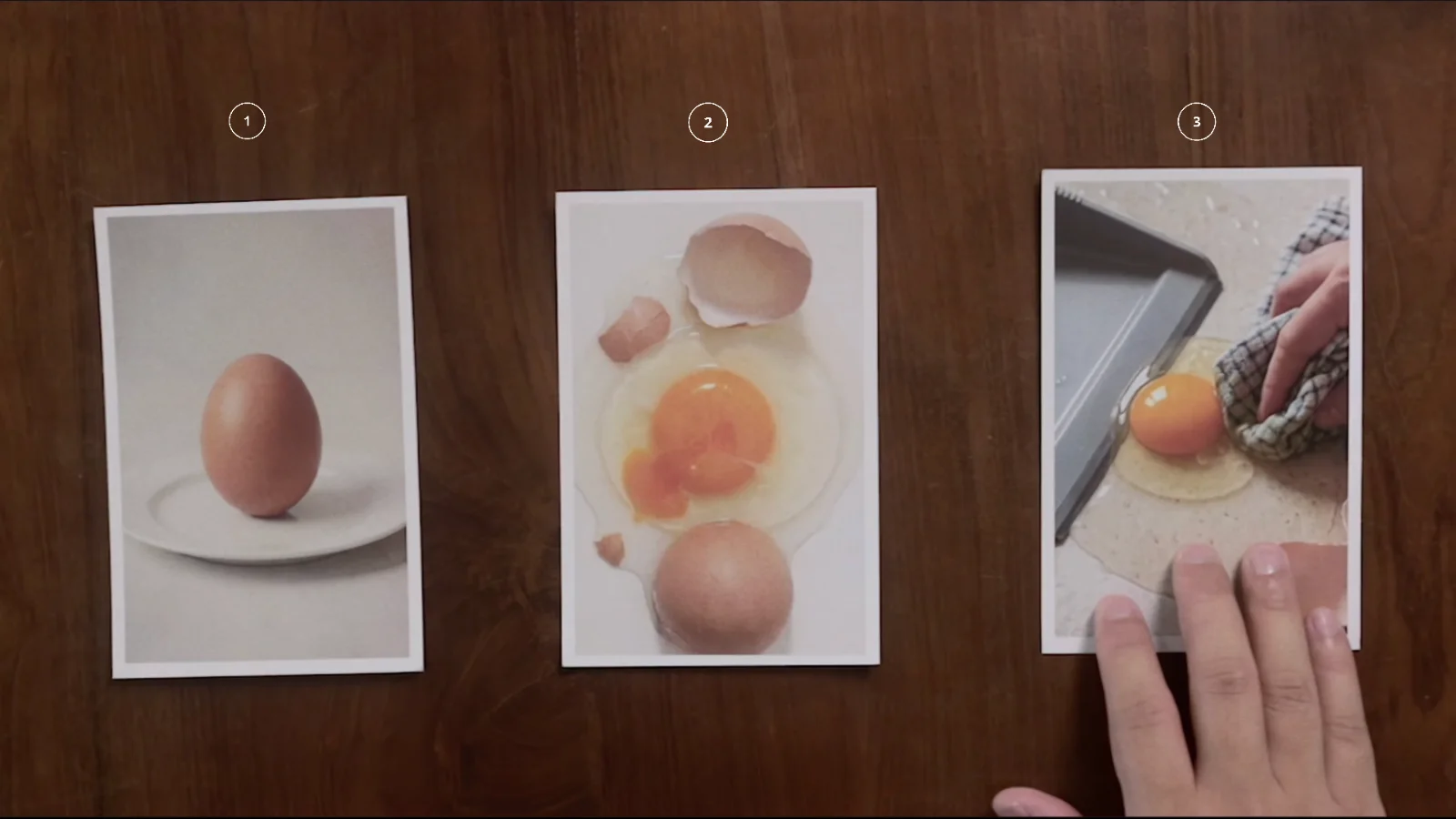
Could Time Run Backward
Can you tell what likely happened before Picture 2? You probably thought of Picture 1, and you'd be right! But what do you think comes next? Can you guess what happens in Picture 3? Perhaps you won't pinpoint one exactly. It could be that the egg disappears. Or gets swept away. Or rots completely without no one even touching it.
But you see, the third photo wasn't so obvious. How come, in the first photo, we feel so sure that it must be this one? How come the future is all these intricate possibilities, but the past was very certain? And what if we could reverse the order of events entirely? Perhaps reverse the arrow of time?
The Arrow of Entropy
There's a way of describing the entire history of the universe. As we know it all starts with the Big Bang. It is the lowest-entropy state the observable universe has ever been in. And every moment since then has been entropy climbing, currently sits at roughly 10 to the power of a hundred and four, in Boltzmann units.
So in one sense, what we're describing is a direction. From an extremely low-entropy state at the beginning, to an inevitably high-entropy state at the end of everything. And it's that gradient that gives the universe direction. A sense that things were one way, and then became another.
"We think we know what entropy is. The number of ways you can rearrange a system. We think it makes sense that entropy increases over time."
Sean Carrol
And in between those two endpoints is where all the interesting things happen. While at the same time, there's galaxies colliding in another region of the universe. All of human experience and everything we've ever known, happens during this brief structured passage between the two eternities.
"This might seem completely obvious, but it was a crucial insight. The flow of heat was a one-way process that seemed to be built very fundamentally into the workings of the entire universe."
Entropy can be described as an arrow of change. that transformation happens at every scale, all the time, everywhere around you. Including the change in the bigger picture of our universe timeline.
The Nature of Entropy
In the 1850s, a German physicist Rudolf Clausius was working on a problem. He wanted to understand why heat engines could never reach 100 percent efficiency. No matter how well-designed the engine was, some portion of the input energy always leaked away as waste heat, every single time. What Clausius figured out was that heat is a form of energy with a very specific behavior. It moves from hot objects to cold ones, and once it has distributed itself evenly, it can no longer be collected and used to do work. You see, the conservation of energy still holds. But that energy has become useless.
From this insight, Clausius formulated the second law of thermodynamics. The entropy of a closed system either increases or stays the same over time. This single law explains why heat flows in only one direction, why perpetual motion machines are impossible, and why so many processes in nature are irreversible.
We describe entropy as a count of how many ways a particular state can be arranged. High entropy means many arrangements are possible. And low entropy means very few. The universe doesn't prefer disorder. It's just that disorder has too many more configurations available to it. Now, really look at the world around you. Do you see order, or disorder? When you look up at the night sky, or watch a butterfly coming out of its cocoon, or trace the orbits of planets… would you describe that as a special configuration? Or random disorder? I'll leave that to you to think about.
If you found this interesting, there’s much more waiting in the full video. Check it out through the link below.