A video on interstellar physics · Beeyond Ideas

The Science of
Project Hail Mary

Tau Ceti is 11.9 light years away. Ryland Grace gets there in four years. So is the movie just breaking the laws of physics? Not at all.

Chapter I

The Hail Mary
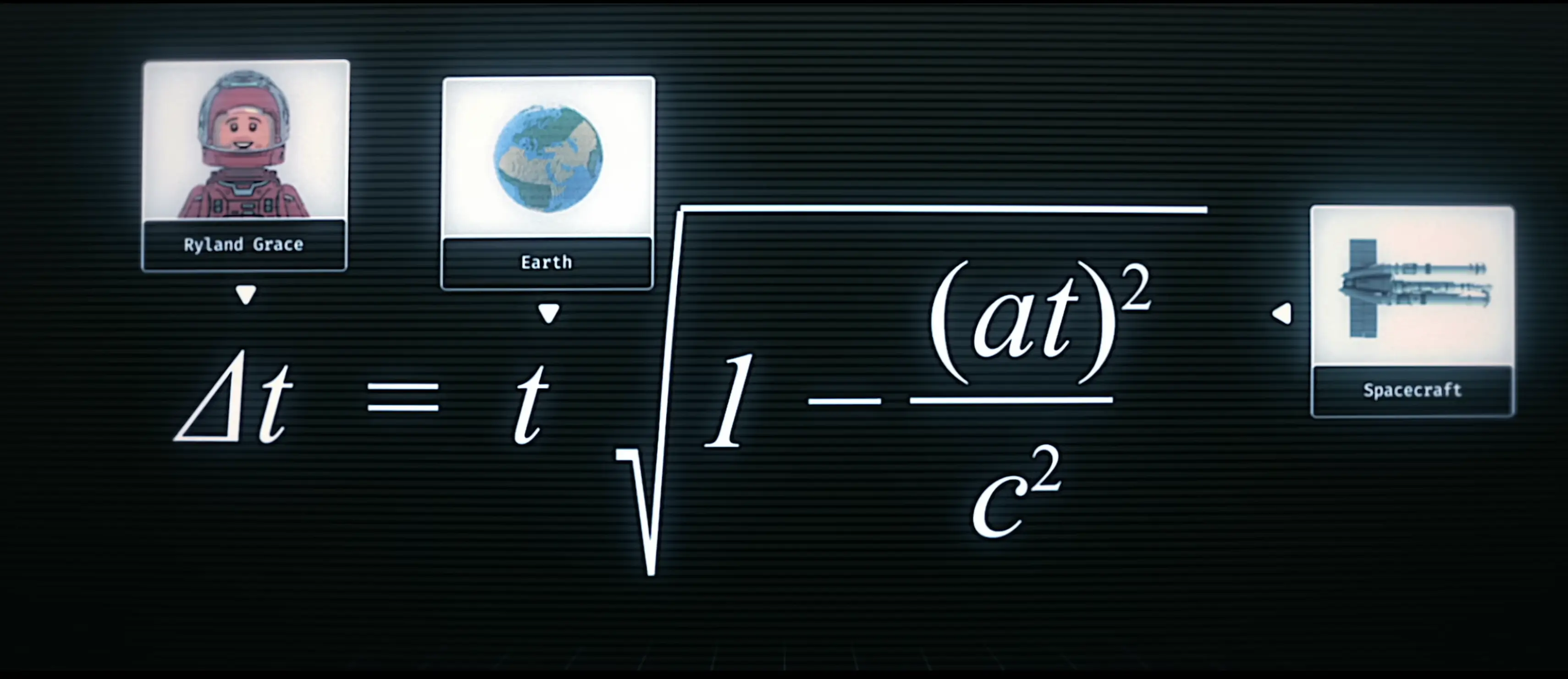
Time dilation equation showing Ryland Grace, Earth, and the spacecraft

This is Ryland Grace. He is on an interstellar mission from Sol, our Sun, to the Tau Ceti system, about 11.9 light years away. And somehow, he’ll get there in just a little over four years.

Yes, you read that right. Tau Ceti is almost 12 light years away, but Grace reaches it in only four years and two months. So is the movie just breaking the laws of physics? Not at all.

He’s actually taking advantage of the very same laws of physics we experience. And E = mc². That’s exactly what makes this journey possible.

Spoiler alert: if you haven’t watched the movie yet, he actually encounters an alien intelligence. But just how likely is it to find intelligent life beyond our Solar System? Or even beyond our galaxy?

Chapter II

The Star-Eater

A Quick Recap

First, a quick recap of the movie, in case you’ve forgotten the plot. The story begins when the Sun, along with many other stars, starts mysteriously dimming because of a microorganism that feeds on stellar energy. Every nearby star is affected except one: Tau Ceti.

“Tau” is the nineteenth letter of the Greek alphabet, while “Ceti” refers to the constellation Cetus. Together, Tau Ceti simply means the 19th brightest star within the constellation Cetus. Just like how Alpha Centauri is the brightest star in the Centaurus system.

Ryland Grace is sent there to investigate why Tau Ceti remains unaffected. That’s why the mission is called Project Hail Mary.

“Just like the phrase in American football, it’s the last desperate attempt with very low odds of success. Humanity is simply hoping for a miracle.”

The crew has to spend years in a medically induced coma. Most people simply can’t survive that process. The failure rate is incredibly high, and only a tiny percentage of humans carry the rare genetic traits needed to endure it, which makes the candidate pool extremely small. Grace is chosen because he has both the scientific background and the genetics for the job.

The mission planners eventually realize that keeping a tiny crew awake for years in deep space is basically inviting disaster. So instead, they remove the human variable almost entirely. Everyone sleeps through the journey and only wakes up once the real mission begins.

The Astrophage

But the real star of the movie isn’t actually Grace. It’s this little creature: the astrophage. “Astro” means star, while “phage” means eater. Quite literally, it’s a star-eating organism. It consumes stellar energy, which causes stars to gradually grow dimmer.

Since Tau Ceti appears to be the only nearby star that survives the astrophage outbreak, the movie suggests it may hold the key to saving our own Sun. Interestingly, Tau Ceti is also broadly similar to our Sun in terms of stellar classification. So it’s at least a plausible place to look for answers.

Einstein’s Equation

Even though the astrophage is entirely fictional, Andy Weir based its underlying idea on Einstein’s equation, E = mc². This formula describes the relationship between mass and energy. In the story, the astrophage absorbs energy from the Sun and stores that energy as mass. Because the value of c² is extremely large, an enormous amount of energy can be packed into a tiny amount of matter.

Basically, it’s the same principle behind nuclear reactions. A tiny amount of mass can be converted into an enormous amount of energy. We built a simulation for this. If you place just one milligram of astrophage inside a solid cube of iron, it melts almost the entire block instantly. And if we scale it to match what’s shown in the movie, that same tiny amount doesn’t just melt the cube. It completely blows it apart.

This is exactly why the spacecraft uses astrophage as its fuel. The engines continuously accelerate at about 1.5 g. That’s roughly 15 meters per second, for every second. So it just keeps getting faster and faster. Unlike a normal rocket that burns for a few minutes, this one keeps pushing almost the entire trip.

Chapter III

Bending Time

The Journey — By the Numbers
Destination
Tau Ceti. About 11.9 light years from Earth. The one nearby star the astrophage spares.
Time onboard
A little over 4 years. Four years and two months, as Grace experiences it.
Drive
Constant acceleration. Roughly 1.5 g, about 15 meters per second, every second. Sustained for almost the whole trip.
Fuel
Astrophage. Mass and energy, bound together by E = mc².
The catch
Time dilation. Earth ages far more than Grace does.

As a result, Grace reaches an enormous fraction of the speed of light, arriving at Tau Ceti after only a little over four years onboard. But Tau Ceti is almost 11.9 light years away. So does that mean Grace is traveling faster than light? Not exactly.

The movie relies on a very real prediction of Einstein’s theory of relativity called time dilation. As an object moves faster and faster, especially as it approaches the speed of light, time passes more slowly for that traveler compared to someone who remains stationary. And that stationary observer is us, here on Earth.

“While many more years pass on Earth, Grace only experiences a little over four years aboard the spacecraft.”

The phenomenon is described by a single equation. Δt is the time experienced by the moving observer, Grace in this case. Meanwhile, t is the time experienced by someone stationary on Earth. And v is the spacecraft’s velocity. But as discussed, the ship doesn’t travel at a constant speed. It accelerates continuously at 1.5 g, so its velocity is constantly changing. That means the amount of time dilation is also changing throughout the journey.

We mapped his entire trip from Earth to Tau Ceti. At the time of launch, the ship is still moving slowly, so there is almost no time dilation. But as the spacecraft keeps accelerating, the effect grows stronger and stronger, reaching its maximum around the halfway point. This is just before the ship flips around and begins decelerating toward Tau Ceti.

And this time dilation effect is made even more obvious in one scene. When Grace’s message finally reaches Earth, Commander Eva Stratt has aged by decades. The wrinkles, the gray hair, everything. Meanwhile, Grace has only aged about as much as you’d expect after a few years of mission. And then there’s Earth itself. Stratt is sailing through this vast ocean of ice. Just look at how much the planet has changed while Grace was away.

According to the movie, if they don’t do something within thirty years, Earth freezes over. The only thing standing between humanity and a new ice age is this one man, floating alone in the emptiness of space.

Chapter IV

Artificial Gravity, From Acceleration

Project Hail Mary introduces a rather different approach to interstellar travel. In many science fiction movies, astronauts experience gravity because the spacecraft spins. That rotation creates an artificial gravity through centrifugal effects. So people are able to walk around almost as if they were on Earth. You see this in many films, like in Interstellar, The Martian, and more.

But not here. Grace isn’t spending most of the journey inside a rotating spacecraft. The Hail Mary ship is capable of rotating, and we briefly see that in one scene. But that’s not how it creates gravity for most of the trip. So what makes this different? The answer is acceleration.

You’ve probably experienced this yourself. When a car suddenly accelerates, you feel yourself pushed back into the seat. It’s not because something is pulling you backward. It’s because your body resists changes in motion while the car accelerates forward beneath you.

If you look closely at the briefing scene, the presentation actually states that the Hail Mary travels using constant acceleration. And this isn’t just something implied by the movie. It’s also verified by the data released by Andy Weir himself. The spacecraft accelerates at 15 meters per second squared, or roughly 1.5 times Earth’s gravity.

The Hail Mary works on exactly the same principle. If the spacecraft accelerates in one direction, the crew feels an apparent force in the opposite direction. The floor pushes against their feet, so to them it feels just like gravity. That’s why Grace can stand, walk around, and work almost normally without relying on a spinning spacecraft.

The Simulations

In the movie, that acceleration is set to about 1.5 g. But in our simulation, you can explore other possibilities as well. We’ve included 0.5 g, 1 g, and even 2 g. As you’d expect, the higher the acceleration, the stronger the relativistic effects become.

For example, if Grace completed a direct return trip from Tau Ceti, the age difference between him and the people back on Earth would be almost 19 years. While Grace experiences only part of that journey himself, Earth continues moving forward in time.

You can also change the destination entirely. Instead of Tau Ceti, you can fly to Proxima Centauri, Alpha Centauri, and several other nearby stars. You can explore the surrounding stellar neighbourhood, visualize nearby stars, and experiment with different mission profiles.

Chapter V

Meeting Rocky

There’s another fascinating idea in Project Hail Mary worth exploring. Eventually, Grace encounters an alien intelligence. And unlike the classic science fiction image of little green men with oversized heads, Rocky looks… well… like this.

What makes Rocky interesting is the way he experiences reality. He doesn’t even see the universe the way we do. Instead of vision based on visible light, he perceives the world through sound, vibrations, and likely parts of the electromagnetic spectrum that humans don’t naturally sense. Just imagine trying to explain color to a creature that has never experienced light. Or trying to explain what Rocky’s world actually feels like.

And this leads to a much bigger question. How common is intelligent life beyond Earth? This exact question was formalized by astronomer Frank Drake through what’s now known as the Drake equation. This isn’t really meant to predict the exact number of alien civilizations. It’s more like a framework. It breaks the problem into a series of unknown factors, and depending on what values you choose for those factors, you can end up with a very optimistic universe… or a very lonely one.

The Drake Equation — Odds of a Neighbour
Our Solar System
Around 10⁻²¹. That’s a decimal point followed by twenty zeros before you even reach the first digit. About the same as randomly selecting one particular grain of sand from all the beaches on Earth, and then doing it again, and again. Essentially zero.
Nearby stars
Around 10⁻⁸. Even if we extend the search to the nearby stars, the probability is still tiny.
40 Eridani
About one in thirty. Rocky’s home system in the movie, under optimistic assumptions. Even within the fictional universe of Project Hail Mary, Grace meeting Rocky is still a lucky event.
The Milky Way
Encouraging, at last. Only when we scale up to the entire Milky Way do the numbers begin to look encouraging, at least under moderate and optimistic versions of the Drake equation.

In other words, the probability per planet may still be incredibly small. But multiply that by the enormous number of potentially habitable worlds in the observable universe, and the expected number of intelligent civilizations increases dramatically. But then comes the obvious question.

“Where is everybody?”

The Fermi Paradox
Chapter VI

A Planet the Size of a Virus

The simplest answer is scale. Here’s one way to picture it. Imagine scaling the entire Milky Way until it’s the size of the North American continent. How big do you think Earth would be? A state? Or a city? Maybe the size of LA? Not even close. Earth would only be about six micrometers across. That’s roughly the size of a single virus.

If the Milky Way were the size of North America, our entire planet would shrink down to something microscopic. So maybe that’s worth keeping in mind. We’re often caught up in our own achievements, our politics, our conflicts, even our own importance. But compared to the scale of the cosmos, our entire civilization exists on a planet that’s almost invisible.

When our entire civilization fits on something the size of a virus compared to our own galaxy, it becomes much easier to understand why we’ve never met anyone else.

“Our universe is operating on a scale that our brains were never built to understand intuitively.”

Chapter VII

Run the Simulations

Now it’s your turn. Explore the physics behind Project Hail Mary for yourself. Adjust the acceleration, swap the destination star, and watch how time dilation reshapes the journey. The simulation below is fully interactive.